You are not logged in. Please register or login.
- Topics: Active | Unanswered
#161 Re: Guns N' Roses » Songwriting Credits » 244 weeks ago
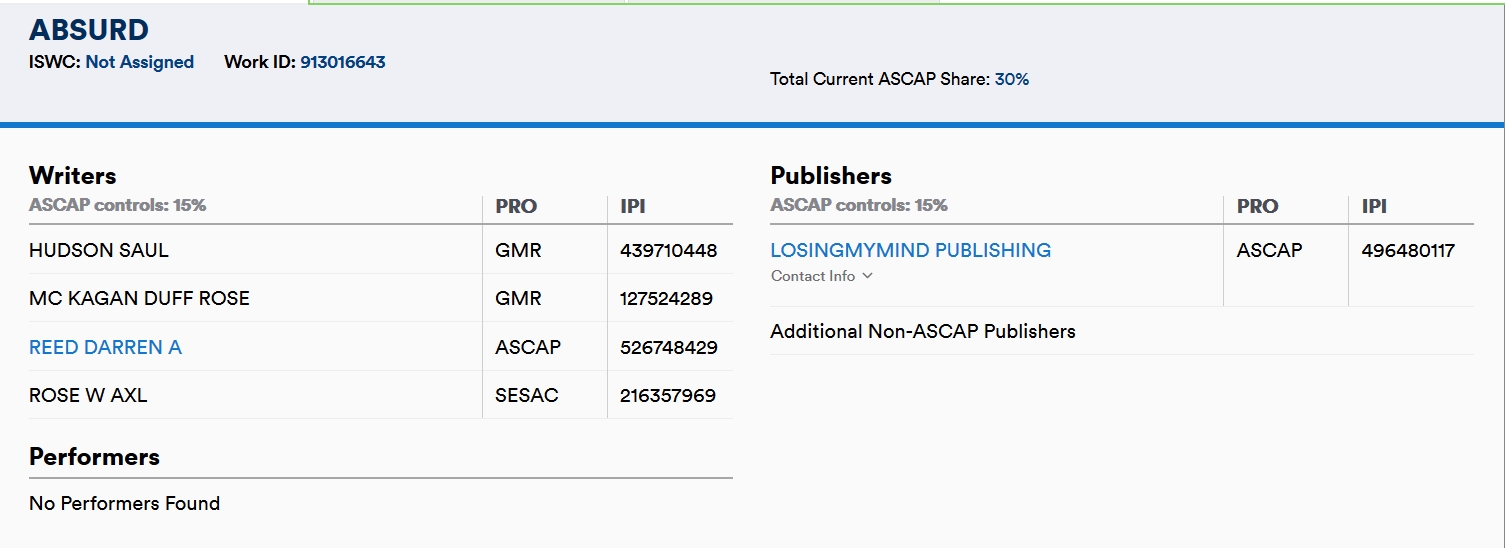
ASCAP controls 30% of Absurd, so that's Dizzy's share on the song, since he's the only one of the listed writers who is represented by ASCAP. So the remaining 70% will be divided between Axl, Slash and Duff.
*
(Note: This post has been updated a few times since first posted. Last update: Nov. 10, 2023)
Maybe someone has done this before, but I had a thorough look at the online repertories of ASCAP, BMI, GMR (Global Music Rights) and SESAC, which are PRO's (Performing Rights Organizations) that collect royalties on behalf of songwriters and their publishers, so they list all the musicians who receive songwriting royalties for each song.
These data are the result of the way a band has decided to split the publishing rights/royalties (i.e. royalties from songwriting) between the members and may not be identical to to the writing credits in an album's liner notes: for example, a band member may not be listed in the liner notes as one of the writers of a particular song, but may be entitled to royalties for it; or the songs may be collectively credited to the band, but in reality not all members get an equal publishing share for them.
GN'R members and outside co-writers are represented by different PRO's:
* SESAC: Axl.
* GMR: Slash, Duff.
* ASCAP: Izzy, Steven, Matt, Dizzy, Paul Tobias, Tommy Stinson, Robin Finck, Chris Pitman, West Arkeen (estate), Chris Weber, Dave Lank.
* BMI: Josh Freese, Buckethead, Brain, Pete Scaturro, Caram Costanzo, Del James.
ASCAP, BMI and GMR report the percentage they control over other PRO's; e.g. for a song listed as co-written by Axl, Slash, Izzy, Duff and Steven, ASCAP reports the percentage it controls, which corresponds to the combined shares of Izzy and Steven, and the same goes for GMR in regards to Slash and Duff's combined shares.
SESAC doesn't provide this information, which would be Axl's share. However, there is another source for that: the database of Universal (which has Axl's publishing) reports the percentage it controls. Universal also has Chris Weber's publishing as far as GN'R songs are concerned, so that makes possible to determine which portion of the share controlled by ASCAP is his, as well as Timo Kaltio's publishing (he's not on ASCAP though, so it doesn't help as much). There are also the databases of PRO's that represent music rights in other countries (e.g. CMRRA in Canada and SACEM in France), which may provide more details about the publishing shares in combination with the main databases listed above, as songwriters that are in different PRO's in the US may be in the same PRO of another country.
1. Appetite For Destruction and GN'R Lies
In the albums' liner notes all original songs are credited collectively to "Guns N' Roses" and, wherever the case, to additional songwriters (West Arkeen on It's So Easy, Chris Weber on Anything Goes, Reckless Life and Move To The City) *
The information in the databases confirms what we know from other sources about how the publishing was split between the members: Axl 25%, Slash, Izzy and Duff 20% each, and Steven 15%.
More specifically:
1) For all original songs with no outside writers: ASCAP (Izzy, Steven): 35%; GMR (Slash, Duff): 40%; Universal (Axl): 25%
2) In the case songs with additional songwriters, as expected, the band members' shares are decreased:
- It's So Easy: 17,5% Axl; 28% Slash + Duff; 54% Izzy+Steven+West Arkeen.
- Anything Goes, Reckless Life and Move To The City: 22.5% Axl; 36% Slash + Duff; 31.5% Izzy + Steven; 10% Chris Weber.
* Note: Live ?!*@ Like a Suicide, which was later included in GN'R Lies, listed individual writers: Axl, Izzy, Slash and Chris Weber for Reckless Life; Izzy, Chris Weber and "DJ" (real name Daniel Nicolson) for Move To The City. However, as evident from the data above, the arrangement changed later with these songs being credited collectively to GN'R and all members (plus Chris Weber) having a publishing share.
2. Use Your Illusion I and II
Unlike Appetite and Lies, the UYI liner notes list specific writers for each song (e.g. Axl and Izzy on You Could Be Mine, Slash and Axl on Locomotive, etc.).
However, that doesn't affect the way the publishing for each song is split: according to the PRO's, the four "main" members (Axl, Slash, Izzy and Duff) get a fixed percentage for each original song written entirely by the band. Only this time the way the shares were calculated was more complicated compared to the shares for AFD and Lies songs, so the percentages are not round figures (according to Slash's book, that happened because they had to calculate a small share for Matt - and I guess Dizzy, too - as well as because of the many outside writers like West Arkeen, Del James, etc.).
For example, although only Axl is credited for writing November Rain in the album liner notes, GMR (Slash and Duff) controls 47.68%, ASCAP (Izzy) 24.26% and Universal reports 26.27% for Axl - and these shares apply for every original UYI song that doesn't have additional writers (the decimals in the ASCAP shares differ slightly from song to song - it may have to do with the publishers). The remaining percentages are obviously Matt's and Dizzy's small shares.
The formula they seemingly used was: first they determined who wrote what (ie. the writers of each songs that we read in the liner notes) and the percentages of each one's contributions to each song (e.g. Don't Cry could be 50% Axl and 50% Izzy); then they calculated all that together and determined each one's shares in the album as a whole (at least the songs that didn't have outside writers), so e.g. Izzy has a share around 24.5% for his overall contributions to the albums; and then they applied those percentages to each song.
So, the fact that, for example, Slash wasn't credited in the liner notes as a co-writer for November Rain and Estranged may affect his share in the albums as a whole, but doesn't mean that he doesn't get royalties for these songs (like when streamed or played on the radio).
* Note: In the 2022 reissue of UYI, the liner notes reflect the real credits that can be found in the PRO's databases, so all members are credited for all songs.
More specifically:
1) Original songs with no outside writers: 26.27% Axl; 24.5% Izzy; 47.7% Slash + Duff; 1.5% Matt + Dizzy.
2) Songs co-written by outside writers:
* Right Next Door To Hell: 50.84% Axl + Timo Kaltio; 32.52% Slash + Duff; 16.18% Izzy. That leaves a small share of about 0,5% for Matt and Dizzy.
* Bad Obsession: 18.38% Axl; 33.38% Slash + Duff; 47.1% Izzy + West Arkeen; 1.14% Matt + Dizzy.
* Back Off Bitch: 21.01% Axl; 38.84% Slash + Duff; 40,15 Izzy + Paul Tobias (+ Matt + Dizzy).
* The Garden: 5.26% Axl; 9.54% Slash + Duff; 54.84% Izzy + West Arkeen. So the remaining 30.36% includes the shares of Del James, Matt and Dizzy (BMI doesn't provide info on Del James' share, but it's safe to assume that it's about 29%).
* Don't Damn Me: 21.89% Axl; 40.44% Slash + Duff; 20.22% Izzy; 16.66% Dave Lank. That leaves about 0.8% for Matt and Dizzy.
* Yesterdays: 8.67% Axl; 15.72% Slash + Duff; 68% Izzy + West Arkeen + Billy McCloud. So the remaining 8.92 includes the shares of Del James, Matt and Dizzy (again BMI doesn't provide info on Del's share).
3. Ain't Goin' Down (pinball machine)
25% Axl; 50% Slash + Duff; 25% Izzy.
4. Shadow Of Your Love
24.38% Axl. The rest is divided between Slash, Izzy, Duff, Steven and Paul Tobias (the databases don't provide percentages).
5. Appetite For Destruction 2018 reissue ("Locked and Loaded") - "new" songs
* The Plague, New Work Tune and Ain't Goin' Down No More (instrumental): 25% Axl; 37.48% Izzy + Steven; the remaining 37.62 is apparently Slash's and Duff's combined share, who are also listed as writers (GMR doesn't provide info).
Izzy's and Steven's combined share appears to be slightly higher than for Appetite/Lies songs, but it might be a mistake on ASCAP's database.
6. West Arkeen songs/"Hell House demos"
* Crash Diet: West Arkeen, Axl, Del James and Daniel Clarke are listed as writers: 31% West Arkeen; 38% Axl. No info on the other percentages.
* Bring It Down Home: West Arkeen and Axl are listed as writers. 50% West Arkeen; 50% Axl.
* Too Much Too Soon: West Arkeen and Duff are listed as writers. 90% West Arkeen; 10% Duff.
* Sentimental Movie: West Arkeen, Duff and Del James are listed as writers. 75% West Arkeen; 25% Duff + Del James (the databases don't provide info).
* Just Another Sunday: No information at all (most likely because it's not on the West Arkeen tape).
7. Hollywood Rose songs (The Roots Of Guns N' Roses album)
* Killing Time and Rocker: 50% Axl; 50% Chris Weber.
Interesting that Izzy doesn't have a share, although he probably co-wrote these songs. Maybe he didn't care to pursue it, but apparently Axl did.
8. Chinese Democracy + Oh My God
Like on UYI, the credits in the album's liner notes list specific writers for each song. But, in this case, the publishing is also split on each song separately. However, the album credits don't completely coincide with the names found in the repertories: in some cases, the latter list additional names. The are also some differences between the credits in the liner notes in the regular album artwork ("bicycle" cover) and the ones in the alternate artwork ("red hand" and "grenade" covers), which suggests that there were probably mistakes in the liner notes.. So the data provided by the databases about the percentages they control on each CD song may be actually informative, at least to an extent, about each member's contributions.
It seems that Axl reserved a fixed 50% for himself for lyrics, melodies and probably arrangement and production. Then his percentage might increase depending on the part he had in writing the music. So, for example, it appears that Axl wrote most of the music on Prostitute (since he has 90%) and a big part of the music on I.R.S (since he has 75%).
Specifically (marked in red are the additional writers that are listed in the repertories but not in the album's liner notes - I have gone with the liner notes in the alternate album artwork):
* Oh My God: 50% Axl; 33% divided between Paul, Sean Riggs and Tommy; 15% Dizzy; 2% Josh Freese.
* Chinese Democracy: 50% Axl; 27% divided between Josh Freese and Caram Costanzo; 21% divided between Dizzy, Paul, Robin and Tommy; 2% Eric Caudieux.
* Shackler's Revenge: 50% Axl; 20% divided between Buckethead and Brain; 25% divided between Pete Scaturro and Caram; 5% Robin.
* Better: 50% Axl; 50% Robin.
* Street Of Dreams: 63% Axl; 37% divided between Dizzy, Paul, Tommy and Robin.
* If The World: 55% Axl; 45% Pitman.
* There Was A Time: 50% Axl; 50% divided between Dizzy, Paul and Tommy.
* Catcher In The Rye: 67% Axl; 33% divided between Dizzy, Paul, Tommy and Robin.
* Scraped: 52% Axl; 24% Buckethead; 24% Caram Costanzo.
* Riad N' The Bedouins: 50% Axl; 50% divided between Dizzy, Paul, Tommy and Robin.
* Sorry: 50% Axl; 33.33% divided between Buckethead and Brain; 16.67% Pete Scaturro.
* I.R.S.: 75% Axl; 25% divided between Dizzy and Paul.
* Madagascar: 50% Axl; 50% Pitman + MLK estate. Universal database also lists a version without credit to the MLK estate in which Axl's share is 67%, so it's safe to assume that Pitman's share is 33% also in the version with the MLK speech, which leaves 17% for the MLK estate.
* This I Love: 100% Axl.
* Prostitute: 90% Axl; 10% divided between Paul and Robin.
9. CD era songs reworked and released by the NITL lineup
As far as the "liner notes" go, there seems to be a return to the Appetite/Lies formula (which is a common formula used by many bands): the songs are credited collectively to "Guns N' Roses" (however, according to a press release issued by the band for Hard Skool, the song was written by Axl).
Regarding the publishing shares, although there seems to be a similar pattern with CD as far as Axl's share is concerned, the difference is that now Slash and Duff get a cut from the remaining percentage (apparently as part of an arrangement for agreeing to work on these songs). Judging from the data so far, it seems that Slash and Duff's shares are not fixed, but depend on how many other writers there are. It should be also noted that there may be additional factors affecting these shares; for example, Slash's and Duff's shares are all theirs, since they're their own publishers, whereas a portion of Axl's share goes to Universal, since it has his publishing (usually the publisher gets 25%-50% of the artist's share, but in Axl's case it's likely that Universal gets more because of the deal Axl signed in 2005).
So in this case the shares are a bit less representative than the ones on CD about who wrote what, however they do provide an insight.
* Absurd: 49% Axl; 30% Dizzy; 21% Slash + Duff. Pitman is not listed as writer.
* Hard Skool: 76% Axl; 11.5% divided between Tommy, Robin and Paul Tobias; 1% Josh Freese; 11.5% Slash + Duff.
So it seems that Axl wrote a big part of the music for Hard Skool besides the lyrics, similarly to I.R.S.
* Perhaps: 70% Axl; 30% divided between Slash, Duff and Paul Tobias (no information about the exact shares).
So it appears that the song was mostly written by Axl.
* The General (listed on SESAC and other PRO's as The General and Monsters): 40% Axl; 60% divided between Slash, Duff, Brain, Steve Freeman and Marc Haggard (no info on the exact percentages yet).
Note: Steve "Extrakd" Freeman and Marc "Mirv" Haggard have written songs with Brain and Buckethead.
#162 Re: Guns N' Roses » Songwriting Credits » 244 weeks ago
ASCAP has two versions of Ain't Goin' Down listed, one is (apparently) the instrumental and the other is the one that was on the pinball machine.
#163 Re: Guns N' Roses » Songwriting Credits » 244 weeks ago
Ain’t going down instrumental was on Locked and Loaded. Could that be it?
It's listed on ASCAP, too, and it says "USED IN A PINBALL MACHINE GAME":
https://www.ascap.com/repertory#/ace/se … /310650847
There's also "Ain't Goin' Down No More" (that was the original title) and Adler is included in the writers, so I suppose this one is the instrumental:
#164 Re: Guns N' Roses » Songwriting Credits » 244 weeks ago
I just looked through the list on globalmusicrights.com. Why is Ain‘t goin Down listed there? Was it ever officialy released or could it be a sign of things to come a la Shadow of your Love?
I see it listed as "AIN'T GOIN' DOWN":
https://globalmusicrights.com/Search?q= … mask=SLASH
(It's right under Absurd)
#165 Re: Guns N' Roses » Songwriting Credits » 244 weeks ago
Blackstar wrote:Absurd has now been added to the GMR (Slash and Duff's PRO) and ASCAP databases. The SESAC database (Axl's PRO) has yet to be updated. Pitman is not listed among the writers/royalties receivers:
https://globalmusicrights.com/Search?q= … mask=SLASH
https://i97.servimg.com/u/f97/20/05/33/00/gmr10.jpg
The retconning is now truly official.
It doesn't bother me...this is the only way we were getting anything...but it's still crazy to see unfold.
On the other hand....
Maybe Slash and Duff were always in one of the shadow lineups.

Yes, I don't see how it could be done any other way. No one would expect Slash and Duff to agree to play on Axl's CD era material without getting credits and with a bunch of former members getting credited.
#166 Re: Guns N' Roses » Songwriting Credits » 244 weeks ago
Hmmm so did Pitman just write the intro and that siren synth then??? Reed is listed so at least it seems that finck and BH will get credit for other songs. I still think it is scummy how they are just saying written by GNR so the casual fans think axl slash and duff wrote it. Also how can Slash and Duff have a writing credit when they are literally just playing the BBF version?
ASCAP and the other similar organizations are about who gets royalties, not about who really wrote what. Sorum and Dizzy are listed as writers in the ASCAP database for the UYI songs, even though they're not credited as writers in the albums' liner notes and didn't write anything.
So it doesn't necessarily mean that Pitman wrote only the intro or that Buckethead and Finck will get credits on other songs. Axl, most likely, owns the copyright of everything written during the CD era, so he doesn't have to give credits - or maybe there's been a deal with the former members and they'll get paid a fixed amount without being credited. It also seems that there's been an agreement between Axl, Slash and Duff about how to split the publishing rights.
#167 Re: Guns N' Roses » Songwriting Credits » 244 weeks ago
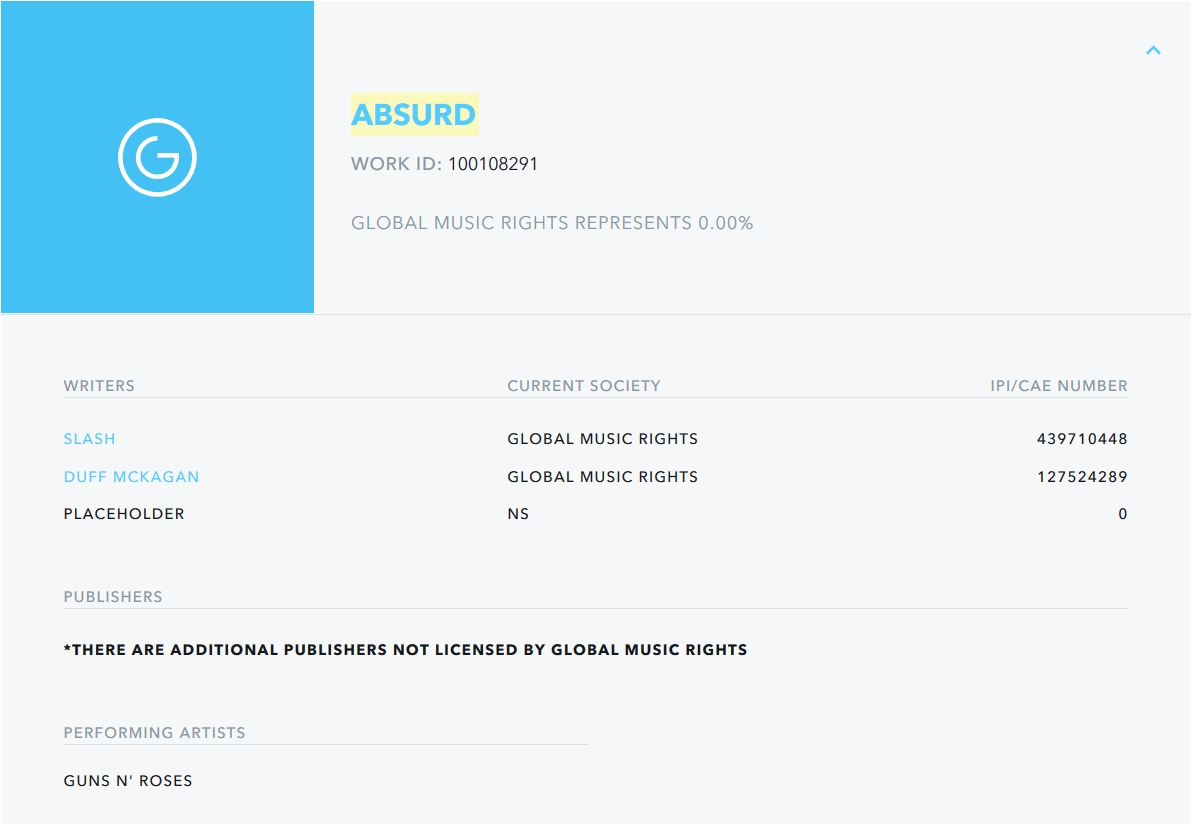
Absurd has now been added to the GMR (Slash and Duff's PRO) and ASCAP databases. The SESAC database (Axl's PRO) has yet to be updated. Pitman is not listed among the writers/royalties receivers:
https://globalmusicrights.com/Search?q= … mask=SLASH
https://www.ascap.com/repertory#/ace/se … /913016643
#168 Re: Guns N' Roses » GN'R 2021 Tour Thread » 245 weeks ago
polluxlm wrote:Izzy doesn't make any sense. His departure was not wanting to be around drugs, the pressure of a big band and the many incidents with Axl. Nor has Axl kept much of a grudge towards him. Izzy leaving the band did not impact GN'R except for the writing aspect, not something Axl's ego cared about then or now.
Slash on the other hand left the band partly because he didn't want to play anything other than old school hard rock. He wanted to keep it real and not deal with all that computer shit. Him leaving ended GN'R as a band and turned world opinion against Axl. As we know Axl had a massive hard on for decades because of it.
That's not how Axl took his departure, how devastated he was, and it's clear with how he still talks about Izzy (Izzy is how he is) that Axl doesn't share the same sentiments about Izzy and their history some forum fans do. The "cool" part always stands out to me.
It very well could have been both, but .... I don't think Axl was as understanding towards Izzy leaving as people might think.
The "cool" part, yes... Izzy has been often been described as being "cool." But "play it" cool? I don't think Axl would say that about him. Izzy didn't "play it" cool, he was just Izzy.
On the other hand, Slash was the one, who, according to Marc Canter, would say things "to look cool," like pretend he was above caring about something, even though he did in reality.
#169 Re: Guns N' Roses » GN'R 2021 Tour Thread » 245 weeks ago
I'm convinced that Hardschool is about Slash. It's like Axl's version about Slash's "trial period," as he expressed it in the forum chats, as well as his 1996 fax (and the sentiments behind them), made into a song:
Axl, prompted by the label and his legal team, made every sincere effort to keep Slash in the band, hence the "trial period" ("All cautions made..."). And if Slash had made the effort, too, Axl wouldn't hesitate to "extend himself" and forgive him and his "lies." He thought that Slash would be "more of a man" and wouldn't "throw it all away." But Slash "had to play it cool," do it his own way, and quit. Axl saw Slash's quitting as a strategic power play move - and it probably really was, at least to an extent - to make him cave in and retract from taking legal control of the band: Slash didn't think that Axl would seriously continue without him, so he'd call him back and he could return under better terms. But Axl wasn't going to cave in. He wouldn't let Slash win have it his way; if he wanted back, that would be in Axl's terms. Slash said he quit and pretended to be cool about it? He'd show him now. So "You thought you were here to stay"? He sent that fax telling him that yes, he'd make a record without him.
Izzy's departure affected Axl a lot, too, both personally and in regards to the band*, but their falling out wasn't so deep, and they kept trying to reach out to each other.
* Actually, at the time, Axl was probably the only one who was fully aware of the long-term negative effect Izzy's absence would have in the band, especially in the writing process; Slash realised that, and Izzy's role as a balancing factor in the band's dynamics, only later, when time came to make a record; he had thought that they'd have been fine making an album with Gilby, like the Snakepit album.
When Izzy left, he and Axl had a long phone conversation, where they agreed that Izzy would go back to write with the band and that they'd meet to discuss that further in person - it was probably then that the idea of a more "fluid" version of the band, more of a project than a conventional band, had started taking shape in Axl's head: since Izzy's issues had mainly to do with the tour, the band could write with him and tour with someone else. But, in the meantime, there were words, Izzy said something to Duff about Axl, Axl heard about it and got angry, so when Izzy went over to Axl's house to talk, Axl threw him out. Izzy went back for the 1993 shows, he asked for money he said he was owed, and had another falling out with Axl and Slash. Then in 1995, Duff, who was the only one who had kept in touch with Izzy during that whole time, invited him to write some songs for GnR, and Axl and Izzy reconciled there for a minute, but fell out again after a conversation over the reasons Izzy had quit and allegedly Axl digging up stuff said 15 years ago. Sometime in 1999 Izzy knocked on Axl's door and wasn't let in. But, about a year later, Axl reached out to Izzy asking him to play in Rock in Rio and, some time later, for the 1995 demos. They started talking at some point in late 2005.
#170 Re: Guns N' Roses » Axl's optimism in 2002.... » 249 weeks ago
That Spinner interview with Del James was definitely staged for Axl to vent about certain people and things. Axl didn't do himself any favors with that interview.
*
Axl had done a third (apart from Spinner and Billboard) interview after CD was released, an email interview with veteran music writer Gary Graff (he's been interviewing/writing about GN'R since the 80s), which, oddly enough, slipped under everyone's radar (!) although apparently it's been out there all this time. I found it by chance a few months ago:
https://www.theoaklandpress.com/2009/03 … -the-fans/
G’n’R: Axl Rose talks to Gary Graff about his new album, rumors and the fans
By Gary Graff
PUBLISHED: March 2, 2009
Axl Rose has never been a talker.
Since Guns N’ Roses emerged during the mid-’80s, the band’s enigmatic and iconoclastic frontman — now its unquestioned leader and sole remaining original member — has kept his own counsel and has kept quiet and out of the public eye. And, he acknowledges, it’s cost him.
“I didn’t talk forever,” the 47-year-old Indiana native, born William Rose Jr., notes. “If I talk I need to ‘shut the f– up.’ If I don’t talk, it’s much worse.”
But these days there’s much to talk about with Guns N’ Roses — as if there weren’t before.
In November, Rose and his latest group of musical cohorts released “Chinese Democracy,” an album that’s been in the making since the early ’90s and has been the subject of considerable speculation and reportage of massive costs (reportedly more than $13 million), release dates and in-fighting that saw band members drop away one by one — including guitarist Slash, bassist Duff McKagen and drummer Matt Sorum, who went on to form Velvet Revolver.
Nevertheless, interest in GN’R remained high. Chalk some of that up to multiplatinum albums such as 1987’s “Appetite For Destruction” and the two volumes of “Use Your Illusion” that came out in 1991. Rose took incarnations of GN’R — including longtime keyboardist Dizzy Reed and former Replacements bassist Tommy Stinson — on the road at periodic intervals, previewing the new songs and enduring a few Internet leaks of the material.
At this point, three months after its release, there were hopes that “Chinese Democracy” would be a much bigger deal than its proven to be. The album — a sweeping exposition of epic, richly produced rock, which debuted at No. 3 on the Billboard 200 chart — has sold less than 600,000 copies in the U.S. though 2.6 million copies worldwide. The domestic number is a disappointment, and it has set fingers pointing. Rose feels his record company, Interscope, did not put enough muscle behind it. Some feel Best Buy, where it’s been sold exclusively, did not put forth enough of an effort — and certainly nothing close to what Wal-Mart did for AC/DC’s “Black Ice.” And let’s not talk about Dr. Pepper’s botched promotion to distribute free soft drinks to celebrate the release.
Still others blamed Rose for not being willing to do interviews — though he did trade comments with fans on the Internet — and didn’t have the band ready to tour to support the album’s release.
He’s talking now — sort of. What follows are excerpts from a lengthy e-mail interview solicited prior to the release of “Chinese Democracy” and updated afterward. Whether “Chinese Democracy” is ultimately deemed a success or failure, its long gestation guarantees it a place in rock lore forever, and Rose’s insights only add to that status.
How does it feel finally having “Chinese Democracy” out? Was the gap between albums frustrating for you or was the process of making of the album its own kind of reward?
Rose: “Ha! Last thing anyone wants to read about are MY frustrations! It feels great!! There were rewards, of course, mainly in meeting and working with the players involved that — no offense to anyone — you could only wish you’d met sooner in life. But no (frustrations with) recording or with those involved but with whatever else was going on around (it). It was pretty ugly for the better part of the duration. That said, being a part of the material personally and with these people means a lot to me.
How much of the past 13 years of making the album was focused on creative concerns vs. distribution/release/commercial concerns?
Rose: This is the closest to the real issues of the record I’ve seen from anyone over this entire time. The reality is that most of my creative energy was used in any area other than music … just navigating through the mine fields — which so far we’ve managed, maybe not so pretty, but an album that many said would never be released by a guy that was either supposed to be dead or kill himself at this level’s not so bad. And (the music is) not as horrific as many predicted, in our opinion, which is a bonus.
What was the overall creative mission or goal that you felt in making these songs?
Rose: No. 1 was just to be involved in what I felt was a good record that I could stand behind with confidence, with no shame artistically, to know that I gave the public our best efforts with no compromise and no holding back. To have the material not be as self-destructive as I have tended to be but still have power. To deal with real and personal issues that may be a bit uncomfortable to embrace … in an effort to help anyone who might benefit. To push the envelope with guitars working together. To not be quite as dated as some predicted or expected. To have an album for Guns fans (who) may have gotten past or are dealing with destructive influences in their lives could enjoy as a positive progression. For the music not to feel worn down, so as to be somewhat giving rather than taking. To be a bit different and its own thing in some way as other Guns albums were, at least to some extent.
What’s the overall impact you want the album to have on its listeners?
Rose: I would just like people to feel a bit better or refreshed and that maybe some feel a perhaps much-needed release in whatever area it may affect them and maybe some are even inspired. The list goes on, and I feel that I achieved a lot of these things to some degree or other. Whether anyone likes it or not, it’s an extremely special guitar record in that so many influences styles and players creating this tapestry is fairly hard to come by, the same with the various drum and rhythm approaches or styles.
What kind of impact did time make on the album we’re hearing now? Are there specific songs or parts of songs you can point to that benefited from the years spent on the album?
Rose: There’s not a song that didn’t gain something from the time and elements that happened in recording as things progressed — different players, new gear, new ideas, lots of things. Regardless of what nonsense was going on both behind the scenes and publicly, the album … continued forward.
What were your thoughts and emotions as you changed personnel throughout the course of the making of “Chinese Democracy” — especially as Slash, Duff and Matt stopped being part of GN’R? Could that older lineup of the band have stayed together and, if so, under what conditions?
Rose: The question seems to incorrectly and perhaps unintentionally imply … that I was changing or attempting to change the musical approach of old Guns. Part of that, I feel, may have come from Slash painting a rather distorted picture publicly, both back then and since, of what our studio was like during his trial period. Contrary to his accounts, there weren’t tons of computers, keyboards and endless, useless gear around that anyone was paying insane prices for. What in my opinion are Slash’s aversion and fears have been greatly amplified and exaggerated and often in complete juxtaposition to and a subversion of reality to support his case publicly at both ours and the fans’ expense.
I know that I wasn’t opposed to anyone from then … and tried anything I could, or that anyone else could think of, to allow that to happen at the time. … The end of each relationship was devastating and terrifying, (but) … no, there wasn’t any way I’m aware of, then or in hindsight, to have kept the old lineup together, at least (by) myself or anyone involved in our camp at the time. In regard to those who came and went in Guns since, and were a part of “Chinese,” some left amicably, some in other ways that had different effects on everyone involved. I think with the album’s release we made it through a good number of those, and what were hard feelings in some areas are water under the bridge now.
When did you actually know, or feel, the album was finished, and what told you that it was?
Rose: Working with Bumble’s (guitarist Ron “Bumblefoot” Thal) fills, (drummer Frank Ferrer)’s additions and various intro bits etc., a lot happened in our final month of mixing as well as in mastering. Thank God for (mastering engineer) Bob Ludwig and his patience.
A line like “Why would I choose to prostitute myself to live with fortune and fame?” (from the song “Prostitute”) sounds like a pretty direct and explanatory statement about your attitude. True?
Rose: In this business, someone is always telling you why to compromise on every issue imaginable. Generally … it’s just personal interests as opposed to what’s best for the music or anyone involved, and least of all the fans, regardless of their preferences. It’s about money in the short term. However you can be used to make whatever anyone can for whatever reason is important to them for the quick buck that’s what you deal with 24/7.
Ultimately, did you have a mostly good time making the album? And how close does it come to the initial vision you had for it?
Rose: No, not really, but I like the people (involved) and what we were able to accomplish. It was much better than previous lineups, and if not for the ugliness around us and the circumstances I’m sure it would’ve been much more fun. I’m very happy with the album, looking forward to audiophile and Blu-Ray mixes at some point if we’re lucky, as that’s really what it was designed for since first hearing about Blu-Ray.
What is your sense of how the world at large views GN’R at this point?
Rose: I think there’s a lot of things to clear up and I wouldn’t presume all that much. … I’m not so sure the world at large cares one way or the other. It’s a big place with a lot of people into different things, but some would like a good show from us, so if we can get there, we’ll do our best to bring it.
How do you feel about selling the album exclusively at one place?
Rose: Fine. It’s not like we had that many options — get f—- by Interscope or wait till next year with another retailer.
Are you happy with the way Best Buy has handled things?
Rose: In many ways, yes. In many areas, they’ve been great. I’m not clear how much the record company has helped them yet, though.
“Chinese Democracy” is very much an album. Are you at all concerned that in an iTunes era, people aren’t interested in entire albums anymore?
Rose: “Chinese” doesn’t have a pretty road in front of it, but it was never going to. It is an album. That’s how it was crafted and meant to be. I tried to deliver something I felt was good … and let others find out if there’s anything there for them. There’s a lot there, so there might be something. I was always the one who liked the albums (that) bands made that weren’t necessarily their most publicly acclaimed (or) their bigger commercial hits — meaning that I enjoyed other approaches than what a band’s mainstream fans felt defined them. “Appetite” was influenced by a number of (those); it took a good while to catch on. It’s … possible to make something that works better as an album and not so much as singles.
Is the measure of “success” for “Chinese Democracy” purely creative, or are there external and commercial measures as well?
Rose: I think that’s a great question. I would say it has more than one life or is a bit multi-tasked or faceted. The creative comes first or … should be the deepest, then there’s getting it across as you put it. And if you can have some fun it’s even better. Those are elements that have been part of Guns. We had some great times touring in ’06-’07, and it looked like others did as well. As long as the music and performance come first then, anything that contributes to that is great.
