You are not logged in. Please register or login.
- Topics: Active | Unanswered
#461 Re: Dust N' Bones & Cyborg Slunks » Duff: Quit Whining About SOPA and PIPA » 746 weeks ago
But at the end of the day, the very companies that are protesting the bill could have avoided this by policing themselves. They refused, for obvious reasons.
Yes, very obviously reasons indeed: it's not their place, nor is it their right to police other people's businesses. That's what the legal system is for. Again, the tools already exists, people are already using them. No need for new legislation.
#462 Re: Dust N' Bones & Cyborg Slunks » Duff: Quit Whining About SOPA and PIPA » 746 weeks ago
I think as internet speeds increase movie piracy will get worse. It's very do-able here but it does consume bandwith. If you could torrent a movie as fast as a CD then they'd be equal.
I agree..but I think they find that value because now they get the music free
Which is my point: If you have X dollars a month for A, B, C in entertainment and you find a way to get A for free, then you spend the whole on B and C.
But eventually the people who make A need to be paid.
So do the people who make B and C. If the people who made A made an attractive enough product, made it easy enough to get, made good promotion for it, etc... maybe they would take back some of those B and C sales?
So what it comes down to for me is that if people are finding more value in other entertainment - why is that? It's because they can get music anyway illegally.
Rather than choose between a DVD and a CD, you just buy the DVD and torrent the CD, then you get both.
You know, I think you're really just assuming music is being hit much harder than the other industries here. I don't know if you've read my follow up post (answer to Atari), but I think movies are being torrented WAY more than music. You're entire argument is based on the unproven assumption that music has a tougher time standing up to piracy. I don't believe so, and in all honesty, I have yet to see (non-industry sponsored) statistics that back this up. Me personally, I never download music. There's very little need with legal and mostly free services like Spotify available to me. I do download roughly 100GB of TV series and movies every month, but that's not even illegal here in Belgium and most of Western Europe. But let me tell you something, I rarely buy a CD anymore either. There's just nothing good enough to own that's being released on major labels anymore these days. Last album I bought was by a Belgian band called Ostend Powers, who I had to e-mail to get the album as they don't have a record label. Their album was recorded & mixed in two weeks in a pro studio for 300€ a day, and the production value is through the roof. They've sold around 1000 CD's by now, at 10€ per disc. I dunno, that seems to work for me.
If your net connection is up to it you can torrent the DVD too, then you can maybe go buy a ps3 game or go get some beers or something. I think the spending is the same, but that the industries who'se stuff is made free will eventually be destroyed if it continues.
I think in 2012 the "size" argument no longer applies really.
That was the height of Napster's popularity, but in the social context of a shift in regular people's mindset from music being a paid commodity to being free, Napster was just a stepping stone.
In music-stealing terms it was an early adoption technology, made popular with college kids. In the global terms of the music trade the 26 million people using Naspster wasn't that much...but as each one closed a new service opened and piracy moved from a nerdy college thing to do to becoming mainstream.
Before limewire was closed 17% of the US internet population was using it.
And that's without all the other services.
I don't know where you get the 17% figure, but at it's height in 2006-2007 the gnutella network had roughly 4-5 million active "nodes" (extrapolation, last known figure as 3 million in january 2006). Nothing compared to Napster.
The impact you are looking for took a couple of years to kick in because of the size of the whole.
I agree that the growth of the phenomenon is gradual, but almost as a direct result of that the impact should have been immediate whenever one of the biggest services was shut down. It wasn't.
Megaupload was claiming to have 50 million users per day!
Yes, porn is responsible for quite a large chunk of day-to-day internet traffic  . But again, if there is a real correlation between sharing and music sales, we should see a huge rise in music sales over the coming weeks & months. Interesting times indeed.
Not sure I follow you there. No one wants to shut down legitimate places to buy singles like Amazon and Itunes do they? They just want you to pay for the products you consume
I'm saying that government intervention through SOPA/PIPA would be on the same plane as government regulation forbidding iTunes. Not saying they are doing this, it would be too silly for words. But so were SOPA/PIPA.
One more, just to be sure. An independent study in Sweden shows that file sharers and non-sharers buy roughly the same amount of CD's, however file sharers buy MORE singles from legal sources like Amazon & iTunes than non-sharers. Again, show me the correlation between sharing and the decline of the music industry.
(oh, by the way, source: http://www.techdirt.com/articles/201111 … hand.shtml )
Factors that are MUCH more likely to be reason for the downfall:
- The lack of quality being pushed by big labels
- Focus on singles instead of albums
- No big national network to promote music anymore (wtf MTV?!??)
- Unrealistic pricing schemes
- Economic downturn
- Audiences with shorter attention span, lots more one-hit wonders
- ...
#463 Re: Dust N' Bones & Cyborg Slunks » Duff: Quit Whining About SOPA and PIPA » 746 weeks ago
Would be curious if Axl commented on this.
I think it's painfully obvious how Axl will feel about this; his stereotypical reaction is usually to blame anyone else for his problems anyway, I doubt he'd see things differently on this issue.
#464 Re: Dust N' Bones & Cyborg Slunks » Duff: Quit Whining About SOPA and PIPA » 746 weeks ago
Ummm.... Yeah torrenting a PS3/X-Box360/Wii game and putting it on your PC is so easy.
Modern console games are not easy to emulate on PCs due to additional tech. needed.
As far as DVDs go, they only came out a decade ago in full force, obviously it would have grown since 99.
When it comes to films vs. Music. getting quality from a film picture requires more effort on average than 320Kb Music. 95% of the net is spam/virus sites as far as streaming goes, meaning the average person will download. You then go to a torrent website and what file is bigger? That film is likely more than 10x the file size of that album you want to download.
Well, okay, you make a fair point sir. The threshold to pirating games is definitely a bit higher than the threshold to pirating music. I don't agree about music vs video though... not at all. The majority of pirated stuff just happens to be video, check this top 100 on pirate bay: http://depiraatbaai.be/top/all
That said, I should have expressed myself differently, what I said was not exactly what I meant to say. What is probable more correct is that I think that if there was a real one-on-one correlation between piracy and a downturn in the entertainment industry you would see it happen for video, music and games alike. Maybe not to the same degree, but the trends should at least show a visible change on key points in history, such as the Napster shutdown. It just doesn't.
#465 Re: Dust N' Bones & Cyborg Slunks » Duff: Quit Whining About SOPA and PIPA » 746 weeks ago
Ok, so in the end the discussion is mostly about whether or not you believe the entertainment industry is really dying. So check out this graph, these are the actual figures for entertainment industry turnover in the UK: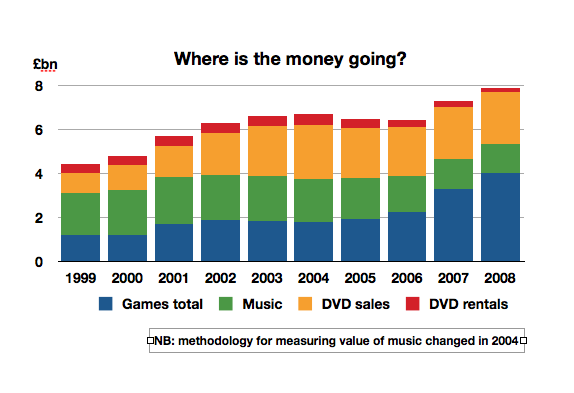
I think it's fair to say that games, movies & music are all roughly equally susceptible to piracy, so why is it "just" the music industry that is suffering? Also, overall spending is up, not down. Might it not be that people simply find more value in other entertainment. By the way, Napster was at it's height of popularity in February of 2001, with 26 million users worldwide, I do not see even the slightest dent in the graph at that point. Actually, the music industry only started declining AFTER the shutdown of Napster in July 2001. If the impact would have been as big as everyone was stating them, slow pick-up of alternatives should have meant a jump in music sales figures. It didn't.
Could it not be because almost every digital download store is focused around singles instead of albums? Look at this chart (US figures):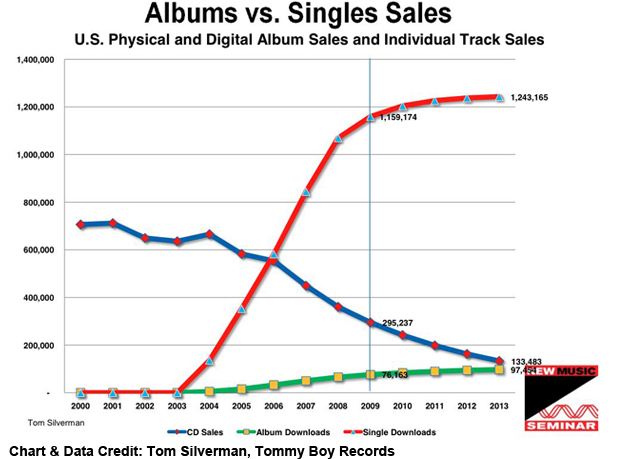
Maybe, the digital age's biggest impact on the music industry has not been piracy but the fact that people now have the option of choosing only the tracks they like, cherry picking their songs.
Now, I know this is going to sound like a huge extrapolation, but for me legislation against sharing is in essence the same as legislation against selling singles. Both allegedly have a negative impact on the music industry, both are a reflection of what users want and how they value the product. Maybe music just worth as much anymore to us, amidst the wealth of other options.
#466 Re: Dust N' Bones & Cyborg Slunks » Duff: Quit Whining About SOPA and PIPA » 746 weeks ago
Design law protects some things, copyright others, and patent law others, all types of IP
I might be oblivious to the specifics here, but I do not believe there is an actual distinction in the law between "design" for clothing which is considered an artistic expression & music or film. Are you sure you're not referring to trademark law (logo design falls in that category).
I just figure that unless we want to go back to patronage or some type of other way to pay artisans to be professionals and dedicate their time to making music/movies/books or whatever rather than doing it as a hobby while they work other jobs - then it makes some sense to protect the mechanism for those people to get paid.
Oh, but it does. And don't get me wrong, I'm not advocating that musicians should do their stuff for free. I think we should throw out the industry around it and start paying the musicians instead. You know, for their gigs, or even for their recorded music. Maybe the mucisian can monetize by selling their songs for ads, for other media, etc... As long as we don't pay for the studio bosses, record labels, etc... who no longer play a relevant role in today's society.
I think scale and proportion is actually very important for morality. Hit me in the face not so bad, shoot me in the face is far worse.
That's not scale; scale is about numbers. You're talking about severity or degrees of severity which is expressed by the "what" question (punching vs shooting), not by the "how many" question. I also disagree with you that the volume has actually increased that much.
A high-end studio including engineers will cost you roughly 600$ / day, so recording the album will cost you no more than 18000$. t doesn't take a math genius to calculate the insane amounts of money that sticks to peoples hands along the distribution chain.
Ok...so to this I say...
1. I guess it depends on what I mean by pro sounding and what you mean by the money that sticks to people's hands. I have a protools set up and record some good sounding guitar at home - but I can't make shit sound as cool as someone line Randy Staub who did Alice in Chains' Black Gives Way to Blue can....but to get someone like him on my album it's more like $10,000 a track.
Well, that's actually more about skill. And I would be inclined to say that the skill required to write a good song is a lot more important in the overall quality of the product. I have a Logic rig, and I can churn out 100% pro sounding stuff, it's just my song writing that's not up to snuff and the reason why I'm not "hitting it big".
2. Even if you are right and it is $18k, if we make all the end product free - how is this cost recouped? I know I don't have $18k to put into my project easily, and if I do find a way to get that money, I want at least a hope of breaking even one day. Bottom line - if something costs money to produce - it's not unreasonable to expect money from people's use of it.
Well, you could consider it marketing money for your concerts, that would be peanuts in comparison. That said, as mentioned before, I don't think it should be free. It should be much cheaper than what it is today and it should be within a price range that can be covered by ad revenue.
1. CD Sales have droped a staggering amount since 2000. If this is not due to sharing - what caused it? The end of the Vinyl-CD replacement cycle is one factor - as is market demographics and stuff, but the figures are overwhelming.
Do you have a source for this? Do you have non-industry funded research that shows the correlation between piracy and a drop in music sales? In reality, no study has been able to show that sharing has had a major impact. In reality, the average person's monthly entertainment budget has remained pretty much constant over the past decade. It might have shifted from albums to singles or to on-demand TV or video games; but the overall budget is roughly the same. Isn't a bit of a stretch then to claim all those lost revenues for the entertainment biz?
2. Intellectual property was invented to encourage people to spend the time, effort and in some cases dollars it takes to create unique profit and develop new works, ideas, inventions etc....if we want to start cancelling these protections on a wholesale level - then we really need to have a sociological discussion about the pros and cons of such a move. There's areas where IP law now inhibits progress - eg patent abuse in computer companies and drug companies...but then to suggest that it's ok to just ignore copyright without replacing it with a system to otherwise compensate those who make the content seems ill advised to me.
Nobody is talking about dropping IP. It's about sanitizing IP to be more in-line with society's demands and sensitivities; I think we both agree on that, but we disagree on the direction the sanitizing should go.
Although we disagree on everything..great post though....I find all this stuff very interesting
And that's another thing we DO agree on 
#467 Re: Dust N' Bones & Cyborg Slunks » Duff: Quit Whining About SOPA and PIPA » 746 weeks ago
Design law is an entirely different branch of IP...I agree the crossover between various areas in law is odd though...
Are you saying that somehow making music is better/more important than designing clothes? Why is it ok for one branch and not ok for another?
As for the stealing issue. I think the industry is misguided if they treat EVERY download as a lost sale, as there's songs you might enjoy if they're free but that you would never pay to own. But that said, there are no doubt LOTS of downloads where the person would have purchased the music if buying it was once again the only easy way to have it in acceptable quality.
But it isn't, and that's just technological progress for ya. There's no actual reason why these people's jobs need to protected from technological progress, just like in any other business. Again, it's about the fact that we don't want to have special rules for a specific industry because they've swindled us into believing their more entitled.
The thing with coping being this harmless thing is that the scale is a lot smaller with the other historical devices you mention too.
Yes, and throwing one can on the street instead of in the garbage isn't going to destroy nature either. Scale is not a consideration for morality, some acts are wrong and some aren't and if you thought it wasn't wrong before then you probably should agree that it's not wrong today. And if you really do wanna discuss scale, think back to how many albums you actually bought versus the number of cassettes you copied from friends. It might not have been 1-to-many, but it was many-to-many which in the end probably boils down to the same thing.
Bottom line to me is it costs money to make songs in good quality, and if everyone expects to have them free then there's no economic incentive to do it. I know, I know, the tours pay for stuff now right? But I don't hear many people enjoying the current ticket prices. Meanwhile classic acts have no motivation to release new work on that model.
And this is where the reasoning really falls flat, imho. I absolutely HATE this argument. It really doesn't cost a lot to make good quality recordings. If you take away all the excesses some bands allow themselves while recording and go back to the essence of recording music, a complete album is recorded and mixed within 4 weeks. Two weeks of recording, 8 days of mixing and 2 days of mastering. A high-end studio including engineers will cost you roughly 600$ / day, so recording the album will cost you no more than 18000$. But if you really want to make pro sounding albums on the cheap, you need around 8000$ worth of gear and some time on your hands. Next album will cost you time only. It doesn't take a math genius to calculate the insane amounts of money that sticks to peoples hands along the distribution chain. There is absolutely no reason why we the people should keep on supporting/enabling this.
So there's two basic arguments I'm trying to put forward:
1. sharing is not destroying the music industry at the pace people are claiming.
2. The music industry has no inherent right to stop us from sharing their creations. Other industries don't, so why should they?
#468 Re: Dust N' Bones & Cyborg Slunks » Duff: Quit Whining About SOPA and PIPA » 746 weeks ago
polluxlm wrote:Copying is not stealing. It's just copying.
That is true for the honourable people that then go and pay for everything they copied.
However in the instances where this doesn't occur, you have taken for free a product produced by an artist who wanted to be paid for it. Call it what you want but it's immoral.Radio taping wasn't as bad because the copies were inherently inferior to vinyl (and subsequently CD) so it didn't discourage legitimate purchases to the extent that torrenting a lossless exact replica of a professional product someone else bought does.
No and no. First of all, you're not stealing anything if the other person is not losing anything. Equating piracy to stealing is like equating yelling at someone to beating the crap out of them... both of them might not be much fun but I think we both agree they're in a different ball-park altogether. There's nothing actually lost in the case of sharing (which is a much less negatively charged word for "piracy").
Second, technology is always going to progress beyond what you can predict so using that as a benchmark for what is legal and what is not is not a good place to start from.
Maybe a bit of a history lesson is in order... 'cause what most people seem to forget is that the only reason why copying music seems to have lost public moral support is because for a very long time they (the industry) controlled the entire supply chain and duplicating anything without their permission in an acceptable quality was basically impossible. Along came the compact cassette, the miniDisc, the CD-R and eventually the internet and changed that. At that point, there was a whole period in time during which technology existed to copy without any specific laws against it (except basic copyright law). Industry started lobbying the US government to do something about the unauthorized copying and reselling of their music (rightfully so), hoping it would have the collateral impact of wiping out sharing as well (wrongfully) as they saw that as a growth opportunity for them. Luckily, the audio home recording act (1992) specifically allowed sharing and other fair use scenarios, much to the industry's dismay. In 1992, so no exact copies could be made at that point (well, DAT was around since 1987 but too expensive for most and miniDisc was only released that year) and they just basically dropped it. Only since the internet and the CD-R have they slowly started molding public opinion to frown on sharing as something immoral and illegal but in most countries, it just wasn't. In came the DMCA making it illegal to circumvent copy protection, but not the actual act of copying, as that to this day is still 100% legal. In most countries, you can actual share your own copies with your friends and family as well under fair use policies. But somehow, the RIAA has gotten us all to believe that such a thing is despicable.
Did you know that if Channel designs a frock anyone can take their design, copy it at verbatim and sell it as their own? The only thing they can't do is copy the logo/name but that's because of trademark law, not copyright. So why is the music industry somehow better than the fashion industry?
Or maybe people are more easily persuaded by an artist's point of view? http://www.jonathancoulton.com/2012/01/21/megaupload/
#469 Re: Dust N' Bones & Cyborg Slunks » Duff: Quit Whining About SOPA and PIPA » 746 weeks ago
Not a conspiracy theorist at all usually, but this is very strange and disturbing in light of the recent megaupload crackdown.
#470 Re: Dust N' Bones & Cyborg Slunks » Duff: Quit Whining About SOPA and PIPA » 746 weeks ago
On the broader issue of piracy I'd say that "piracy" and home copying is the nett result of an open demand-and-supply economy and I for one support it.
The whole business model of the content industry is based around the fact that they control supply. Unfortunately for them, technology has progressed in such away (as tends to happen) that this control has shifted towards the people. Instead of fighting to keep control by lobbying for new legislation maybe the industry should have chosen more customer friendly ways of creating additional value? Maybe they should shift focus back to performances instead of recordings?
I mean, in all honesty, the government didn't try to stop the advent of the automobile although it had a severe impact on the livelihood of farriers. Demand for horse shoes has gone way down since the late 1880's, but these people either moved on to other businesses or stayed and found their place in the niche their market had now become. That's just the way society progresses.
Anyways, the entire recorded music industry is only worth around $28 billion, including retail and distribution (so it's fair to say that the music creation industry is going to be a fair bit smaller than that estimate). Google alone is worth almost double that, why do these relatively small businesses wield such great power over the legislative process in the US and internationally? Universal Music is only worth around $6 billion, Sony music a bit less and Warner only $3 billion.
Google has $26 billion in CASH, they could theoretically just buy the music industry as a whole, give the product away for free and it would still make perfect business sense for them... obviously, this would never get regulatory approval but it's a thought exercise worth doing for the arrogant pricks at Universal, Sony & Warner music groups. Time for them to get their feet back on the ground and realize the real value of what they're doing.
